The Makings of a Lake Forest College President
Tracy Wamarema ’28
Staff Writer
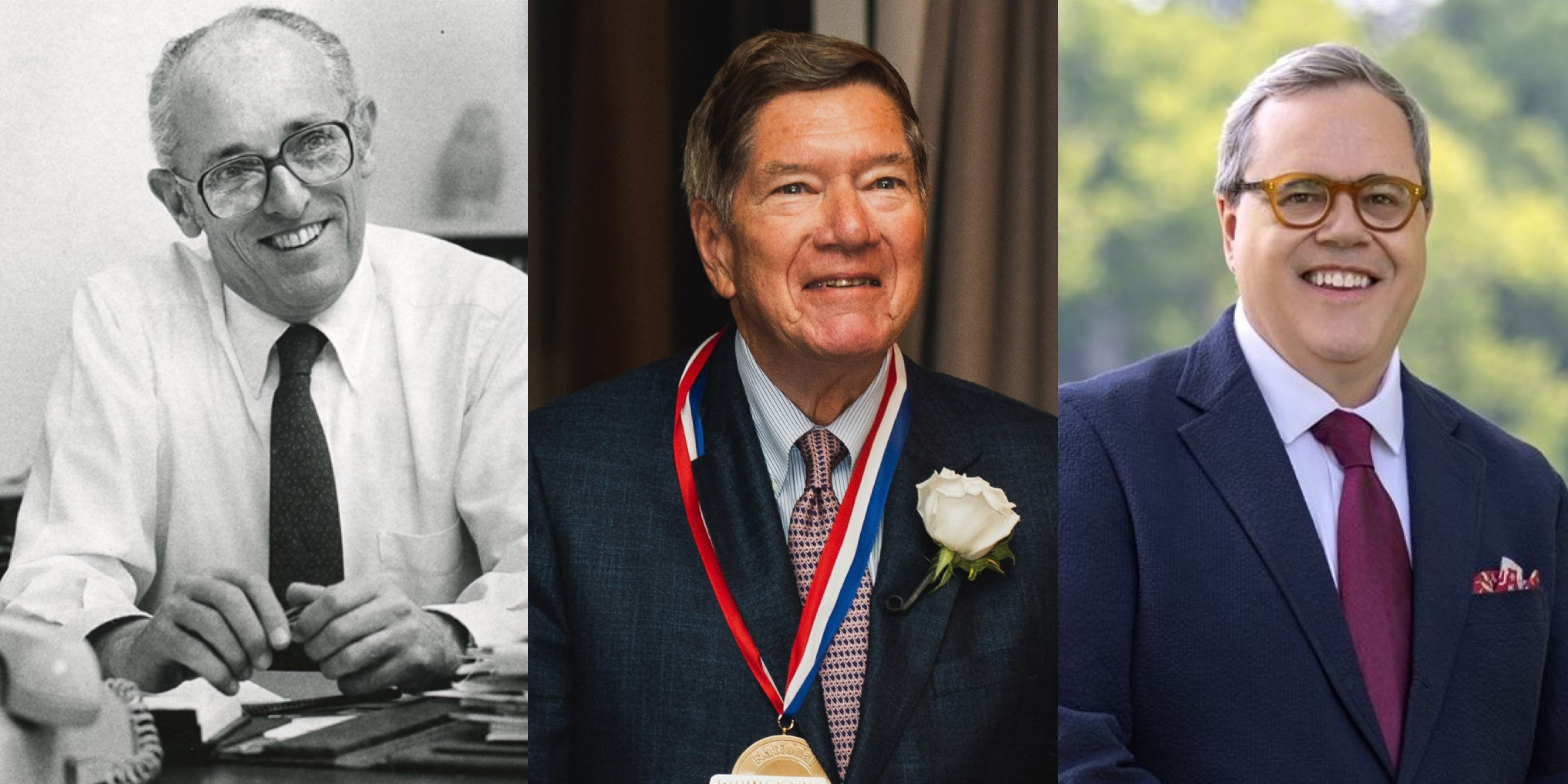
This summer, Lake Forest College saw a rare convergence of leadership. On June 26, the community grieved the passing of President Emeritus Eugene Hotchkiss. Shortly after, Interim President Robert Krebs concluded his tenure as Dr. Michael Sosulski was named the College’s fifteenth president. Both Sosulski and Krebs were present at Hotchkiss’ memorial service in Reid chapel on August 23 underscoring a continuity of leadership. The occasion raised a deeper question: what makes a Lake Forest College president?
A Legacy of Leadership
Gene Hotchkiss led the College for 23 years, making him the longest serving president to date. In 1990, he invited Rob Krebs to join the Board of Trustees— a position Krebs continues to hold. Decades later, Krebs was among those who unanimously appointed Mike Sosulski as president.
“People want to have a leader with character, who stands for something and can articulate that and is willing to stand behind those principles,” Sosulski said.
Building for the Future
Fundraising has long been central to Lake Forest’s success. In 1970, Hotchkiss inherited a college with strong academics but weak finances. By the end of his tenure, Hotchkiss had stabilized college funds and strengthened Lake Forest’s national profile.
That legacy continues. During his interim leadership, Krebs helped raise $52 million giving Sosulski a “running start” towards the College’s $175 million endowment campaign. “The reason I love endowment is that crucially, it supports scholarships to make the education that we offer accessible to people who don’t always have the ability to pay the full amount,” Sosulski explained. Furthermore, endowed chairs for faculty ensure that wages are covered without needing to raise tuition.
“Everybody should have the right to a great education that prepares them for their lives,” said Krebs.
Leadership rounded in compassion
At his memorial, Hotchkiss was remembered for three key values: compassion, integrity and honesty. Whether biking across campus or welcoming students into his home for dinner, he always led alongside the community rather than above it.
Sosulski, once titled the “People First” president, embraces the same ethos. Shortly after his first Board of Trustees meeting, he emailed the community a summary of the discussion— a tradition he intends to continue. “You can only get the community to buy into a vision if you are authentic, clear and transparent about the goals and the obstacles,” said Sosulski.
Under Krebs’ interim leadership, the college formally adopted new Community Values— curiosity, accountability, intellectual inquiry and engagement— which Sosulski fully endorses.
“Education cannot exist in an environment where freedom of thought and inquiry are not present,” said Sosulski.
Education as a Catalyst
Each of the three presidents found their calling through education.
For Hotchkiss, it came in the form of a telegram offering him a leadership position at Dartmouth College.
For Krebs, it was a semester abroad program in Italy which eventually led to the creation of the Krebs Center for Humanities. “I learned a lot, not only about the world and different civilizations and people with different views, I also learned a lot about myself,” Krebs said.
In similar fashion, Sosulski was shaped by a semester abroad in Germany, where he combined his passion for language and jazz by forming a local band.
These moments of discovery reveal the transformative power of education.
History in Education
Even after retiring, Hotchkiss continued to serve on college boards and in 2000, he stepped in as interim president of a liberal arts college in Florida. Decades later, Krebs did the same— emerging from a 22-year retirement to guide Lake Forest College through a transition. Before that, he chaired the board of a private high school and remained active as a Stanford University alumnus.
Prior to arriving at LFC, Sosulski was president of Washington College and held leadership roles across multiple institutions.
For all three leaders, education has always been more than a profession— it has been a calling.
Appreciation for the Liberal Arts and Lake Forest College
The liberal arts education specifically has been a unifying passion for each of the LFC presidents.
“I always felt like liberal arts schools were the backbone of the American education system,” said Krebs.
Sosulski agreed, praising the system for teaching students to think critically across disciplines. “The liberal arts model combines depth with breadth. It’s the best training for the unknown,” he said.
He added that the College’s close-knit size fosters a community of care. “It’s a combination of that really smart curriculum in a community where we’re not going to let you fail,” Sosulski said.
That commitment to student success is also what drew Krebs to LFC.
“Three things make us special,” said Krebs. “The first is you get a grounding in a liberal arts education that helps prepare you for your life and the world you’re going to live in. Secondly, you get some practical applications so you can get a job when you graduate. And the third thing is, you walk into our dining hall and it’s like a microcosm of the world.”
Sosulski too praised the Career Advancement Center saying it was “the best (he’d) ever seen” for preparing students for life after college.
Transformation through Education
From Hotchkiss’ compassion to Krebs’ steady service to Sosulski’s forward-looking vision, LFC presidents share a common philosophy: education as a force for transformation.
“Each one of us is born with our own unique potential and we’re providing the foundation for our students to realize that potential,” said Krebs.
Three presidents, three eras, one thread: leadership rooted in earnest values. That is what makes a Lake Forest College president.